Monday, March 21, 2011
More coming
I am planning posts on implications of the emerging world order on business. Looking forward to new posts!
Sphere: Related Content


Implications for Global Businesses of the Emerging World Order
It appears, on occasion, that we may be seeing the arrival of some new “epoch”, some unpremeditated discontinuity. Socio-political, climactic, natural—all sorts of signals of potentially discontinuous change setting in …
I am not thinking “end of the world”, but fundamental changes to “environment,” that force large adaptive responses across economics, politics, business, etc.
One example, from business world—as “fixed” costs of doing business go up, and products get commoditized, Industries tend to consolidate. I think we are seeing the cost of “Sovereignty” go up, of information go down. Driven by this, we should expect significant impacts on our business model.
Sovereignty is about handing over capital to another entity, which then allocates it, per agreed upon rules, to attain a contracted end, and enjoys complete authority for the period of that contract.
It is said that institutions (Firms, Governments, Military, or Church) exist to allocate knowledge; while transactions serve to allocate capital. An election (or a revolution, as in Egypt) is a transaction in which the rulers are granted the capital to rule. An exchange is where a firm is allocated capital to acquire resources. Investors and electorate hand over direct control of capital because it is more efficient to allocate knowledge (make decisions) within a firm, than in a transactional environment. At the heart of it is the “cost” of making decisions—information gathering, comparison of options, organization of effort, accountability, etc.
Sovereignty produces efficiency when decision costs are high in the absence of that organization.
I think what might be happening is that cataclysmic changes are rendering sovereign organizations inefficient, and stake holders are finding the need and means to directly participate in change. The “complete authority” clause is being supplanted by a “participatory authority” paradigm.
In a world of growing food shortages, direct communication of commodity prices to farmers in India is so valuable, that current systems that restrict such dissemination of information (under the guise of “planned economy”) are becoming too costly for that society. Expect a farmer’s revolt. The demands of Sovereignty to keep China and Taiwan separate are straining under the economic efficiency of value-chain integration. Lincoln’s “emancipation”, and Reagan’s “Freedom” might have been other words for the efficiencies promoted by abrogation of non-economic sovereignties.
I think the changes we are seeing—revolutions, with the demos (people) asserting their opinion directly on the cratos (power/rulers), versus through the controlled cadence of elections—are a signal of the impending cataclysm. But in our case, I feel, there is a Tsunami of change immanent—wrought by natural disasters, food shortages, water scarcity, unemployment, political crises, climate change, all accelerated to warp speed by mutual reinforcement and INFORMATION. (See how, strangely, Wisconsin and Egypt got conflated.)
As costs of sovereignty go up, as they seem to be trending, groupings of states would seem to be indicated to emerge. Unwilling, but economically beneficial groupings are often enforced by war—e.g., the American Civil war, or the WW II (Germany looking to consolidate Germanic people, and access the ports via Lorraine). Arab nations are sub-optimally formed. I’d say regional wars are not out of question, as the economic rational for combining labor and capital-- labor in oil-poor countries chasing capital in oil rich ones, and vise versa. The border with Mexico is better enforced by a recession, and more weakened by a booming economy, than can be explained by Sovereign effort. American Sovereignty is not strong enough to curtail immigration in the long run.
What will test American power more might be the unraveling of the middle-east, because that is where energy and feed stocks lie. Not this year, but over the next decade, America will intervene in the Middle East, Korean peninsula, Indian subcontinent, Africa, Eastern Europe, South China Sea—i.e., EVERYWHERE. UN will lose more credibility. New capital systems will need to be erected (who will buy Afghan bonds?). Information will be key.
Information is a key ingredient of this change. Business in the "Information" value chain, would benefit from this accelerating change, as would businesses and business models that mitigate uncertainty.
Current business model will have to adapt. For example, for business in "Information value chain", with information becoming critical, governments will step-in to their areas of business. These businesses will need to build a strong government-affairs arm to help develop PPP (public private partnerships)-- something they cuurently do, but in a more institutionalized and systematic way. There is a lot of money and power at stake. Also, multinational character might become a liability. Like Unilever, whose local subsidiaries are indistinguishable from local businesses, firms need to learn the art of strategic camouflage, and promote indigenization of resources. It will prove to be a competitive strength. Finally, global firms need to work to promote informational platforms that help sovereign interests—like electronic passports, e-Government, etc
Provided my little theory, that the defining cataclysm of our time is an assault on Sovereignty, is true.
Sphere: Related Content
Monday, October 5, 2009
Letterman and shock culture: Structure, Conduct, Performance
It is a far stretch to insinuate that Mr. Letterman, that avant garde man of letters, in any way engineered the current frakas.
That said, weird as it is, he likely to benefit in the ratings game.
In one of its accidentally successful frameworks, McKinsey came up with the SCP idea to aid Industry Analysis--
(S): Structure: A structure, decided by policy, costs and norms, exists in an Industry. The global steel Industry has huge economies of scale, is faced with buyers that can play on supplier against another, and ore is located far from demand, forcing advantage to mill owners who can buy vast volumes from mine owners and feed it to operations world wide-- it is a structure that favors scale and cross-globe holdings. The Entertainment Network industry has a structure where 70% of eyeballs are attacted by 10% of shows. Loyalty for a successful show can be high if a successful formula and personality are found, eyeballs dictate revenue, and these eyebalss allocate attention by shock value
(C): Conduct: Industry structure drives the conduct of players. The global steel Industry has a structure that favors scale and cross-globe holdings. The Entertainment Network industry has a structure that allocates attention by shock value of conduct. So, steel magnates have tended to consolidate capacity and huge, multinational M&A is common. In entertainment industry, networks seek programs that can shock. Late night shows, more insulated by the norms that look askance at exposure of the young'ns to debauchery, are more free to satisfy this demand for shock.
(P): Performance: How players in an Industry perform is driven by their conduct. Steel Industry has very volatile earnings (performance is cyclical)-- the London Metal Exchange can supply the spot price for steel, making price transparent, and mill owners price takers. Supply-Demand balance dictates price almost entirely. That and fuel cost, but that is baked into all commodities.
The Entertainment industry has become progressively more raunchy. Accidental dissolution too brings disrepute, notoriety, and eyeballs. Eyeballs rule.
So, while David didn't mean for it to be so, his misfortunate dalliance would probably accrue a fortune for his sponsor network. Sphere: Related Content
That said, weird as it is, he likely to benefit in the ratings game.
In one of its accidentally successful frameworks, McKinsey came up with the SCP idea to aid Industry Analysis--
(S): Structure: A structure, decided by policy, costs and norms, exists in an Industry. The global steel Industry has huge economies of scale, is faced with buyers that can play on supplier against another, and ore is located far from demand, forcing advantage to mill owners who can buy vast volumes from mine owners and feed it to operations world wide-- it is a structure that favors scale and cross-globe holdings. The Entertainment Network industry has a structure where 70% of eyeballs are attacted by 10% of shows. Loyalty for a successful show can be high if a successful formula and personality are found, eyeballs dictate revenue, and these eyebalss allocate attention by shock value
(C): Conduct: Industry structure drives the conduct of players. The global steel Industry has a structure that favors scale and cross-globe holdings. The Entertainment Network industry has a structure that allocates attention by shock value of conduct. So, steel magnates have tended to consolidate capacity and huge, multinational M&A is common. In entertainment industry, networks seek programs that can shock. Late night shows, more insulated by the norms that look askance at exposure of the young'ns to debauchery, are more free to satisfy this demand for shock.
(P): Performance: How players in an Industry perform is driven by their conduct. Steel Industry has very volatile earnings (performance is cyclical)-- the London Metal Exchange can supply the spot price for steel, making price transparent, and mill owners price takers. Supply-Demand balance dictates price almost entirely. That and fuel cost, but that is baked into all commodities.
The Entertainment industry has become progressively more raunchy. Accidental dissolution too brings disrepute, notoriety, and eyeballs. Eyeballs rule.
So, while David didn't mean for it to be so, his misfortunate dalliance would probably accrue a fortune for his sponsor network. Sphere: Related Content
Not So Obscure: Paten Law, Supreme Court, and Aristotle's Four Causes
In one of my recent blogs I invoke Aristotle's Four Causes theory-- that an effect has four identifiable causes;
Sphere: Related Content
- Material Cause: the material of which the effect is made (a statue of stone, so the material cause of a statue is stone)
- Efficient Cause: the (physical?) agency that marshals the effort to shape the material (human arms that chiseled the statue)
- Formal Cause: The design that artists mind, or the program that drives the agency in (2) above.
- Final Cause: The purpose that motivates the final cause. For the statue, it may be the need to satisfy a customer.
The Supreme Court recently heard a case on the patentability of software. As you'd see from the list above, it is unclear where software lies between (2) and (3) above. I hold that patent laws have been seen in the US justice system to apply to the "efficient cause". In the case of software, is it the efficient cause or the formal cause of problem solving? I'd say that is the nub of the issue.
I hold that it is the efficient cause, and so should be patentable. Red Hat lawyers, on the other had, do not. They argue,
"the Supreme Court and lower courts had held that abstractions couldn't be patented and that a patent needed to cover an abstraction incorporated into a particular machine, or be a process that "transforms a particular article into a different state or thing," Tiller wrote."
The wording "an abstraction incorporated into a particular machine," suggests they believe the machine is the efficient cause, the code the formal cause. And therefore a machines is patentable, and software not patentable.
This just to illustrate that these philosophical concepts are more applicable than we credit them. And that fasting is productive of philosophical thought.
Saturday, October 3, 2009
Cell Phones Go Fishing: A Case Study From Kerela, India
In a study on the impact of improved information on commerce, Harvards Robert Jensen makes some interesting, though entirely unsurprising, observations.
Sphere: Related Content
In brief, for an extended period before the penetration of phones, fisherman in Kerela had seen their incomes decline. Forced to compete in local markets, at the mercy of local traders, they had seen both prices and volumes decline over the years.
Then with the advent of cell phones, these same fishermen could discover the best prices rapidly, leading to better prices for the fishermen, AND, lower average prices for the customers.
A true Pereto optimality.
More later.
Friday, January 2, 2009
Arab Israeli Conflict: In Search of a Common Enemy?
Perhaps peace will come to the Mid East when the two adversaries find a common enemy. A recent blong-exchange opened my eye to some new facts.
In a blog exchange, "shimshonit" chides me for suggesting (inter alia, in a comment on his blog) that the Arab Israeli conflict is essentially one fueled by hatred, that hatred itself facilitated by symbols of dissimilarity. My thesis being that even when the interests of two tribes are the same, their apparent differences, and the dynamics of power, can result in mindless internecine war (as among the houses of Lancaster and York, the Lilliputians, the Daevs and Asurs, the Marovingians and Carolingians, ad nauseum through history).
Now, I have the deepest regard for the tribes of Issac and Ishmael. The Israeli's are a more peaceable nation, and one with no lesser regard for human life than any other. The Arabs are a prouder folk than any that walked this Earth. Steeped in history and lore, the two are as similar in their sense of destiny, as they are dissimilar in their world views. United only by tragedy, the flip sides of which they share, the one regrettably the fodder for the other's victories, they appear locked in a tragic struggle.
However, this struggle, though very real, is not entirely unavoidable.
Referring back to my post on shimshonit's blog, I state that "The (most) Arabs hate Jews. Jews (many, if not most) hate Arabs." The statement is inaccurate according to him, because, "most Jews do NOT hate Arabs, and there is certainly nothing in Judaism that suggests that we should."
So how do we explain the seemingly excessive bombardment of Gaza-- and it is excessive. He goes on to provide arguments that I will, in all of this blog, fail to counter, viz., " Islam is viewed by Judaism as one of the religions of The Book, and in their avoidance of any graphic representations of God, they resemble Judaism much more than Christianity. If Jews did hate Arabs (Muslim or Christian), they would not treat them in hospitals despite their enemy status, give them the right to vote and hold office, own property, or any of the other rights they are given in Israel."
This is sincere and impassioned polemic. Everything he states is true, and worth quoting. The case he makes, with an eloquence borne out of honest and informed conviction, is true at least for a majority of his compatriots.
And yet, he appears to discount the disconnect between the intentions and beliefs of a people, and the policies and practices of their state. If the state of Israel feared that the Obama administration would be less hawkish than the Bush regime, which is widely expected to be the possibility, and if an election was imminent in Israel, as it is, and if at the confluence of these portends Hamas started inviting Israel's displeasure, then, it is possible, and it did indeed so transpire, that the state of Israel would unleash an overabundance of force against their hapless, if primitive and ignorant, neighbors.
Now, in private discussions there is always a greater emphasis on intent, and in public discourse ever the greater care for appearances. My wise and insightful interlocutor is giving voice to his peoples unquestionable intentions. He is not willing to see that his leaders, individually of an equally sterling disposition, are collectively the practitioners of a less generous creed.
What is this creed? This is the creed of "an eye for an eye." This is the belief that, faced with a fratricidal struggle, the indiscriminate decimation of the enemy's ranks furthers ones security better, than does a reasoned attrition of the hateful few among them.
It is my view that the Israeli-Arab conflict is fueled by parochial hatred and promoted by political opportunism. Israel individuals by conviction, and the state by constitution is inclined to compassion. However, the dynamics of power-struggle among Palestinian factions, and electoral rivalry among Israeli parties sets off a lethal dynamic of belligerence toward the other. In the thrall of this competition, the Israeli leaders all become hawkish, and the thugs within Hamas the more vicious. The more Hamas can constrain Israel to ruthless adventurism, the tighter their (illegitimate) hold on power. The more the Israeli leaders can appear uncowed, even ruthless, the better their chances of (undeserved) electoral gains. The same gullibility of the public that makes it defend its leader's mistakes in such times, also persuades it to hate the projected enemy.
It is this game of hatred that I was alluding to in my comment on his (very interesting) blog.
Now, in no way do I absolve the Arabs, whom you will notice I call "primitive" and "ignorant", of their culpability in the fate that befell them. The Muslims represent, at once, the flower of human progress, and the blight on human weal. They developed and spread science and civilization in a time when Europe was in dark ages, and the East was isolated. But today, lead by greedy and ignorant leaders, the Muslim Umma has come to profess some of the most retrograde views to infect any people.
What the Muslims are NOT is deserving of the current pogrom. My friend makes the error of proposing that, because I watered a man on a Monday, thereby I may torment him on the Tuesday. A peoples virtue does not apologize for their sin, or the transcendental law of Karma would decay into the secular rules of consumer credit.
Monday, December 29, 2008
Why, Gaza? Why Now?
A week king leaves throne, a new prince prepares to ascend. This has always been the time for opportunistic adventurism in the far reaches of the empire. Is that what happened here? Did Israel take these last days of Bush administration, and the cover provided by Hamas's foolish rocket-launching, to make a strategic military move? Sure seems like it.
Here is the self destructive mistake that some Muslim partisans make-- they provoke destruction of their own to engender blind hatred, and from that reap new converts to their brand of militant activists. Or, as the world calls them, terrorists.
If Hamas wasn't foolish enough to launch rockets right now, or ever, and if Israel didn't always have to return Armageddon for fire, the venomous cycle of hatred and war would simmer down.
But Hamas is, and Israel chooses to. In the process, hatred is turning Muslims into self destructive zombies. Is it possible that someone whose father and brothers, children and sisters were killed by mindless enemy bombs will not want to kill that enemy, or die trying?
As Gandhi said, and eye for an eye, and the whole world goes blind.
What is miserable is that each wants "the West," or "the US," or someone to help extricate them from this dynamic. And, when the time comes, the West, or US, or the rest of the world, sets the same example-- of demanding and eye-for-an-eye. Each tragedy, each terrorist act succeeds in lowering the sum total of human sanity.
Israel will never kill its way out of this hatred. I realize that it cannot appear week in that part of the world. But a show of force as brutal as what we are witnessing is hardly proportionate. At what point does the legacy of the Holocaust start getting squandered?
The Arabs will gain little if Israel is made to hurt, or go away, and they loose little if Israel stays. The best revenge an Arab can have on a Jew is NOT hate him, but to outlive and out create him. If the Arabs didn't have this baggage of hatred and victimization, if they could work at building institutions, and developing technologies, they would build a civilization that could outshine the tiny Jewish state in their midst.
Working together, with Israel, they could use their vast resources to dazzle the world.
Instead, we have the horror of Gaza.
Sphere: Related Content
Sunday, December 28, 2008
Image Strategy: Does Israel Need Humanizing?
Brand is not a concept limited to consumer packed goods anymore-- celebrities, organizations, corporations, and countries too are alive to the power of a well managed brand. As they are of a poorly managed one.
Israel is a great example of a poorly managed brand.
" A survey published by the EU in October 2003 revealed that 59% of Europeans believe that Israel constitutes a bigger threat to world peace than North Korea, Iran or Afghanistan. This negative image has a damaging impact on Israel's business activity in the EU. "
(Quoting Emmanuel Navon from http://www.israel21c.org/)
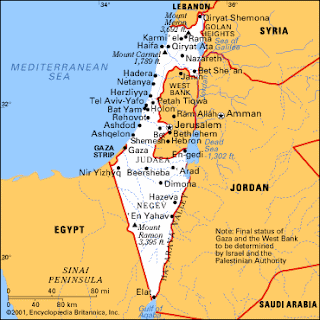
Granted that Israel's brand has not been neutral in Europe as a matter of history. However, as a country actively involved in acts that attract a lot of attention, often controversy, Israel needs active image management if ever an entity did. The more so because in the modern world, where regional contentions get globalized pronto, Israel depends more on world opinion than it would've when Golan heights were annexed. As do the often hapless Arabian bystanders.
My stand on Israel is very similar to my stand on complex social-ethical issues-- I refuse to succumb to simplistic sound bites. An Arab would be pleased to hear that I regret the actions Israel must take to defend itself, but she will be disappointed that I can't condemn Israel unequivocally. Likewise, I am pained at the tragic suffering of our Arab brethren-- I am not an Arab, nor a Muslim. However, who will not be to see such undeserved tragedy?
I believe that most thinking folk are similarly tortured by the realities in the Middle East.
In this backdrop, I wonder if Israel can not help its image by active image-management? Where are the Op-Eds, talk show participants, and even commercials?
Business, too, suffers negative social image very often-- Ikea did after child labor was exposed in its supply chain. In TN a power-company blew it when they caused widespread fly-ash contamination. Union Carbide never did recover from the notoriety of Bhopal. Coke in India was suspected of supplying contaminated drinks-- almost without proof.
It is in defending against social stigma that countries (Israel, Pakistan) and Corporations seem to perform equally poorly.
The problem, I think, is the unwillingness to highlight the good they do in the fear of providing a context to their mistakes.
In this, as in so much more, I think Gandhi set a great example for us. Manchester was the textile capital of the British Empire when Gandhi organized a successful boycott of all foreign textiles. This caused the loss of business to the the mills in Manchester. Even so, not only did Gandhi travel to Manchester, he won genuine local affection there. Why? He respected the contrary point of view, recognized the damage done by his action, and explained the reason behind it.
Now, some of the mistakes that Israel or Ikea make cannot be explained away. However, every company and corporation does a lot more good than it does bad. It is not good intentions or positive results that are wanting, it is an active communication of them.
Brand management is more than advertisements and infomercials. Brand management is more than promotion. Band management is sometimes as basic as the humanizing of an entity.
Which is where Israel has failed. I realize that Israel needs to do a lot more than just talk its good-intentions. However, that doesn't justfy NOT communicating its own constraints and compulsions. Israel needs humanizing-- in word and action.
Do you agree?
(Disclaimer: I DO NOT support every, or even a preponderance of things Israel does. However, I do believe that Pakistan, whose policies I oppose, and Israel, as well as other countries, and even more numerous corporations, fail to humanize their successes and failings. This writeup is about saying "sorry" as much as it is about saying "see how great we are.") Sphere: Related Content
Israel is a great example of a poorly managed brand.
" A survey published by the EU in October 2003 revealed that 59% of Europeans believe that Israel constitutes a bigger threat to world peace than North Korea, Iran or Afghanistan. This negative image has a damaging impact on Israel's business activity in the EU. "
(Quoting Emmanuel Navon from http://www.israel21c.org/)

Granted that Israel's brand has not been neutral in Europe as a matter of history. However, as a country actively involved in acts that attract a lot of attention, often controversy, Israel needs active image management if ever an entity did. The more so because in the modern world, where regional contentions get globalized pronto, Israel depends more on world opinion than it would've when Golan heights were annexed. As do the often hapless Arabian bystanders.
My stand on Israel is very similar to my stand on complex social-ethical issues-- I refuse to succumb to simplistic sound bites. An Arab would be pleased to hear that I regret the actions Israel must take to defend itself, but she will be disappointed that I can't condemn Israel unequivocally. Likewise, I am pained at the tragic suffering of our Arab brethren-- I am not an Arab, nor a Muslim. However, who will not be to see such undeserved tragedy?
I believe that most thinking folk are similarly tortured by the realities in the Middle East.
In this backdrop, I wonder if Israel can not help its image by active image-management? Where are the Op-Eds, talk show participants, and even commercials?
Business, too, suffers negative social image very often-- Ikea did after child labor was exposed in its supply chain. In TN a power-company blew it when they caused widespread fly-ash contamination. Union Carbide never did recover from the notoriety of Bhopal. Coke in India was suspected of supplying contaminated drinks-- almost without proof.
It is in defending against social stigma that countries (Israel, Pakistan) and Corporations seem to perform equally poorly.
The problem, I think, is the unwillingness to highlight the good they do in the fear of providing a context to their mistakes.
In this, as in so much more, I think Gandhi set a great example for us. Manchester was the textile capital of the British Empire when Gandhi organized a successful boycott of all foreign textiles. This caused the loss of business to the the mills in Manchester. Even so, not only did Gandhi travel to Manchester, he won genuine local affection there. Why? He respected the contrary point of view, recognized the damage done by his action, and explained the reason behind it.
Now, some of the mistakes that Israel or Ikea make cannot be explained away. However, every company and corporation does a lot more good than it does bad. It is not good intentions or positive results that are wanting, it is an active communication of them.
Brand management is more than advertisements and infomercials. Brand management is more than promotion. Band management is sometimes as basic as the humanizing of an entity.
Which is where Israel has failed. I realize that Israel needs to do a lot more than just talk its good-intentions. However, that doesn't justfy NOT communicating its own constraints and compulsions. Israel needs humanizing-- in word and action.
Do you agree?
(Disclaimer: I DO NOT support every, or even a preponderance of things Israel does. However, I do believe that Pakistan, whose policies I oppose, and Israel, as well as other countries, and even more numerous corporations, fail to humanize their successes and failings. This writeup is about saying "sorry" as much as it is about saying "see how great we are.") Sphere: Related Content
Saturday, December 27, 2008
Response to Mumbai: India's Options
What are India's options in the wake of Mumbai attacks? Alsol, are we confronted with a discontinuity here-- are attacks of this nature going to remain isolated and rare, or do you believe that a war has been declared on India, and such attacks will now become rampant?
Researching on the web, and within blogs, this is what I find for India's Options:
1. Do nothing (supporting assumption: Mumbai was a freak incident, and will not be repeated again)
2. Accelerate diplomacy with Pakistan (Assumption: They are willing, capable and ready to collaborate, and the all that is needed to facilitate such collaboration is greater exchange of information and views, and that further attacks will be prevented by this)
3. Work toward a diplomatic isolation of Pakistan (Assumption: Interests inimical to India can be weakened, and those likely to cooperate strengthened by such an isolation, and that further attacks will be prevented by this)
4. Work toward economic-sanctions against Pakistan (Assumption: The state is constitutionally opposed to India's weal, and the stress of economic isolation will drive reevaluation of institutional and national agenda, and that further attacks will be prevented by this)
5. Carry out surgical operations against terrorists on Pakistani soil (Assumption: The terrorists are well-identified, and isolated within Pakistani territory, that these attacka will deal a blow to their ability to reconstitute, and Pakistani government will not start supporting terrorists. Finally, that this will not lead to a disproportionate response from Pakistan, nor bring down civilian government, and that further Mumbai-like attacks will be prevented by this)
6. Carry out a full fledged invasion of Pakistan (Assumption: India will be able to permanently cripple Pakistan's ability to threaten India, and prevent Iraq-like instability in its aftermath. That a nuclear war would not ensue, nor will China opportnitstically make advances on Arunachal, etc. All this to prevent Mumbai-like attacks)
In designing such options, and I admit myriad can be made up, we balance the fear that the response will be ineffective (numbers 1 and 2, for example) with the fear that they will be counterproductive (numbers 5 and six possibly)
I think, given current threat level and India's limitations, options 3. and 4. cited above (diplomatic isolation OR economic sanctions) are the kinds we will want to choose from amongst.
Combining them, we can either
A. Go for maximum wattage, and seek economic sanctions against Pakistan, and demand clear, specific, time-based actions against them
OR
B. Build a case for economics sanctions, by allowing diplomatic isolation to fail
My thinking in all this is that India is faced with a secular discontinuity here-- that Mumbai attacks we NOT a one-off incident, but the begining of what will be a sustained campaign against India.
Do you agree? What options will you construct for India?
Sphere: Related Content
Friday, December 26, 2008
A new strategic plank to build Indo-Pak alliance upon
"India cannot prosper in spite of Pakistan, and Pakistan can prosper because of India."
The following is a letter I wrote to Dr. Farrukh at the "Strategic Foresight Group." I will await his response. Meanwhile, your comments are invited.
Hello Dr. Farrukh,
I like your posting, "The Cost of Indo-Pak conflict"
on
http://www.strategicforesight.com/sfgnews_74.htm
Clearly, you are a proponent of peace and sanity, and a defender of the Pakistani point of view. I hope that if I differ with you on the latter, that you'd not discount my devotion to the first (to peace and sanity.)
The core thesis I want to run by you is: "India cannot prosper inspite of Pakistan, and Pakistan can prosper because of India."
To expand on the statement above, there is no way India can be a flourishing democracy without being a growth-economy. To grow, India needs foreign investment, for which it needs security, which it cannot have if the current relations with Pakistan continue. I hope my words don't sound critical of Pakistan-- it is great country, and a greater nation, though a suffering state. But Pakistan has the potential to hold India back.
Equally, India has the potential to help Pakistan grow-- India, with it's mercantile success, experience with democracy and liberalism (I would unhesitatingly accept all specific criticisms of Hindu fundamentals,) and progress on property rights -- can help Pakistan build a stronger economy, fashion stronger institutions, reverse the politicization of the military, and reduce the exhausting spending on defence.
I think the realization (that Pakistan can hold India back) is stronger in the subcontinent, than is the realization that India can help Pakistan grow. The first has built a jaundiced Indian foreign policy, and a militant Pakistani approach. A realization of the second can help reverse the venom of the first.
The flowering of culture and arts that attended the first contact of Islam with India is indicative of the synergy of Islams virility with India's fecundity. In no other country have Muslims created such vast and fabulous empires, contributed so much to arts, learning, and defence.
Where, given today's rancor, do Indians begin to solve the current problem? What do we need to do to fight the impression that Pakistan has succumbed to militancy? Can India do anything to strengthen progressives within Pakistan and weaken the irridentists? Finally, I have long believed that India should recognize the LOC in Kashmir as an international border, and the two countries should move on beyond that dispute-- your thoughts?
In the interest of full disclosure, I am a Hindu, the son of a military officer, grandson of a Gandhian, and now a resident of US, working for a multinational. If you see my antecedents burdened with agenda's inimical to the interests of Pakistan, please know that if nothing, I will be honest with you. Sphere: Related Content
The following is a letter I wrote to Dr. Farrukh at the "Strategic Foresight Group." I will await his response. Meanwhile, your comments are invited.
Hello Dr. Farrukh,
I like your posting, "The Cost of Indo-Pak conflict"
on
http://www.strategicforesight.com/sfgnews_74.htm
Clearly, you are a proponent of peace and sanity, and a defender of the Pakistani point of view. I hope that if I differ with you on the latter, that you'd not discount my devotion to the first (to peace and sanity.)
The core thesis I want to run by you is: "India cannot prosper inspite of Pakistan, and Pakistan can prosper because of India."
To expand on the statement above, there is no way India can be a flourishing democracy without being a growth-economy. To grow, India needs foreign investment, for which it needs security, which it cannot have if the current relations with Pakistan continue. I hope my words don't sound critical of Pakistan-- it is great country, and a greater nation, though a suffering state. But Pakistan has the potential to hold India back.
Equally, India has the potential to help Pakistan grow-- India, with it's mercantile success, experience with democracy and liberalism (I would unhesitatingly accept all specific criticisms of Hindu fundamentals,) and progress on property rights -- can help Pakistan build a stronger economy, fashion stronger institutions, reverse the politicization of the military, and reduce the exhausting spending on defence.
I think the realization (that Pakistan can hold India back) is stronger in the subcontinent, than is the realization that India can help Pakistan grow. The first has built a jaundiced Indian foreign policy, and a militant Pakistani approach. A realization of the second can help reverse the venom of the first.
The flowering of culture and arts that attended the first contact of Islam with India is indicative of the synergy of Islams virility with India's fecundity. In no other country have Muslims created such vast and fabulous empires, contributed so much to arts, learning, and defence.
Where, given today's rancor, do Indians begin to solve the current problem? What do we need to do to fight the impression that Pakistan has succumbed to militancy? Can India do anything to strengthen progressives within Pakistan and weaken the irridentists? Finally, I have long believed that India should recognize the LOC in Kashmir as an international border, and the two countries should move on beyond that dispute-- your thoughts?
In the interest of full disclosure, I am a Hindu, the son of a military officer, grandson of a Gandhian, and now a resident of US, working for a multinational. If you see my antecedents burdened with agenda's inimical to the interests of Pakistan, please know that if nothing, I will be honest with you. Sphere: Related Content
Thursday, December 25, 2008
Five reasons for and against Indo-Pak war
I write this with no levity-- there is a strong case to be made against a war in the subcontinent. There is, however, also a case to be made in favor of one. I'd make the two, and hope to read your comments and views on the topic.
The case against is indubitably fiercely strong and, long term interests given preeminence, a most incontrovertible one. I'd enunciate five "pillar" arguments in favor of Peace in the Indian subcontinent;
However, as I said in the beginning, there is constrained logic that makes a hesitant case in favor of a war
The summum bonum guiding this determination will be the likelihood that a world post war will be better than the world before it. India must go along with such a plan like don Quixote-- in a false belief in its manifest destiny to destroy a chimerical enemy. India must go in knowing it is sacrificing its preeminent interests to "save the world."
The real need here is to fight corruption, build strong institutions, and build an India where all share in prosperity, and opportunity is not limited to the privilaged. That will mean the populace gets over its hysteria, abandons petty differences, and moves decisively to build a modern polity.
Unfortunately, blaming and attacking an easily hated enemy is the easier. Sphere: Related Content
The case against is indubitably fiercely strong and, long term interests given preeminence, a most incontrovertible one. I'd enunciate five "pillar" arguments in favor of Peace in the Indian subcontinent;
- The two nations are nuclear-armed.
- The countries are poor, and densely populated, making widespread misery inevitable.
- A war will make matters much worse
- External interference will increase after a war
- Multinational entities and capital will leave the region in droves, and development and commerce will be set back a century.
However, as I said in the beginning, there is constrained logic that makes a hesitant case in favor of a war
- India, maybe unwillingly and even unwittingly, has become one of the global fronts in the "Jihadists" war.
- What happened in Bombay was not an isolated incident, but one of many others to come, and a confrontation is not a matter of "if", but "when" hostilities breakout.
- A limited theater engagement with Pakistan is possible
- This engagement will lead to a fundamental, structural change in the constitution of the enemy, and lead to a long term solution to the problem
- India is the best placed actor on the world stage to deliver this knockout blow, and would receive broad based support from the comity of nations
The summum bonum guiding this determination will be the likelihood that a world post war will be better than the world before it. India must go along with such a plan like don Quixote-- in a false belief in its manifest destiny to destroy a chimerical enemy. India must go in knowing it is sacrificing its preeminent interests to "save the world."
The real need here is to fight corruption, build strong institutions, and build an India where all share in prosperity, and opportunity is not limited to the privilaged. That will mean the populace gets over its hysteria, abandons petty differences, and moves decisively to build a modern polity.
Unfortunately, blaming and attacking an easily hated enemy is the easier. Sphere: Related Content
Selecting a Mac
For all the new and would be Mac'sters out there-- here is some help for selecting and enjoying your (prospective) assets.
Sphere: Related Content
First, Hersh's five rules of Mac ownership
1. An Apple product lasts, and stays technologically current, for about five years
corollary: In general, the more expensive a Mac, the longer it stays technologically current
2. While an Apple product becomes a very personal possession, the entire family uses your asset in one way or other
3. Apple products retain 80% their value (because of 1. above) for the first two years, and 50% for the first four-- a $1000 computer you bought in 2005 is still worth $700 today. The $500 Dell is selling for $100!!
4. All Apple products work seemlessly for media, document editing, and on the internet. The only problems you'd have are with corporate software, like SAP, etc.
5. The tasks for which companies write Mac versions of PC software, the Mac version is better-- has more features, and is easier to use. e.g., MS Excel for Windows still had a 30 MB file size limit, when the Mac version had no such constraint, AND had strated using the task-pallete later unsuccessfully incorporated in the Windows version of the software.
So, now that you know these general "FAQs," we can answer more specific questions.
1. Mac Book or Macbook Pro?
2. Laptop or iMac
3. When do I buy Mac mini
I will post answers to these questions, but in the meanwhile feel free to email me questions, and post comments.
Happy Mac'ing
Wednesday, December 24, 2008
Preemption: Mercantile and Military
It is important to understand the stakes and strategies defining the current Indo-Pak confrontation. The two rivals have gone beyond the stage of negotiation, and are testing each others resolve. The next step may be a preemptive strike by one against the other, and from there-- war.
In this blog I describe the anticidents of this situation, then create a framework with which to analyze the situation, and finally make recommendations as to the next steps.
1. at least one of the players is known to perceive "zero sum" constraints,
2. both perceiving there to be first-mover advantage or, as is more common, second-mover disadvantage,
3. situational arithmetic prevents cooperation, and
4. there is uncertainty as to the intent of the players
We superimpose on this structure the default game-theoretic constrains (see Hurwicz, Maskin, and Meyerson, 2007 Nobel in economics) viz.,
A. Each player enjoys "selfish agency," and
B. Each sees information and resource asymmetry as a source of advantage
We also assume that Mike Jensen's REM (Resourceful, Evaluative, Maximizing) model obtains-- not so much to simplify our exploration, but more on account of the realism this concession brings to the analysis.
Relevant examples here are
Game(I) Pepsi versus Coke
Game(II) India versus Pakistan
Game(III) Anne Anderson, et al., v. Cryovac, Inc., et al.
We take the first from the business world, the second from politics, and the last from the movie "A Civil Action"-- a combination of the two worlds.
Now, Game(I) has been played out, and we go back to the Cola Wars of the'80's and 90's to revisit the narrative. (I take the Indo-Pak situation very seriously, and am not seeking to dilute that seriousness with this example. I am merely trying to trial-run our model on a non-normative game.)
So, Pepsi and Cola are fighting for market share. And, if one wins, the other automatically loses (market share.) Both expect the other to try and wrest advantage. Both seek agents in this fight-- fans, who amplify their sides message and (wittingly or unwittingly) help grab new Nielsen-points.
To take one example, Pepsi launched what ended up being a very successful campaign-- the "Pepsi Free Stuff" roll out. This helped Pepsi outsell coke in Atlanta, the Mecca of the Co'cola drinkers, during Olympics held in that city. Coke sought to replicate the success of this campaign, but clearly Pepsi had a first-mover advantage.
However, fighting over the Nielsen-points for the two was costly, and was turning effectively into a competition on price and quantities-- you either reduced your price, or sold less. Their agents were acting selfishly, for example when one "Free Stuff" enthusiast sued Pepsi for significant damages.
The wars cooled down when the two realigned their utilities, Pepsi by going for a dominance of the snack market, and leaving the dominance of the Cola world to Coke. The ability of the rivals to recognize the mutually-assured destruction inherent in their competition, and subsequent concessions, helped them cease hostilities.
In Game(III), the case of Cryovac v. Anne, as the movie A Civil Action shows, the two rivals, each seeking to visit examplary punishment on the other, were on a trajectory of a mutually destructive litigious war. However, the presence of an external arbiter (the courts of law) brokered their competing claims to impose a settlement.
When we move to the Indo-Pak conflict, we seek to identify the "Neilson-points" equivalent of this conflict. The candidate quantities could be
1. National security (Mumbai attacks)
2. National honor (Appearance of weakness in the comity of nations)
3. Territory (Kashmir)
4. Chances to win an election (for Congress in India)
5. Control over polity (Pakistan, the Army, vs. Politicians, vs. Militants)
All these are quantities that can be increased and, if they increase for one, the other sees their own utility decrease. Granted that 4. and 5. appear to be, and are, predominantly inward looking sub-games. However, they impose a heavy externality on the relationship of the rivals.
At a superficial level it is #2 that is the key variable that each is seeking to maximize, at the other's expense. In what follows, I posit Honor to be the resource under contention ("Neilsen-Points" or revenge in the the other examples.)
Honor is an "irrational" quantity-- it is subjective and non-material. That said, it is very clear to the partisans as to where the maximization of their utility lies. For India, it is in getting Pakistan to respond by dismantling its version of "Pepsi Stuff" campaign.
For Pakistan, this campaign (involving terrorists as free-agents) has brought them great dividends, and that success has come to imply virtue-- the strategies success against their key nemesis sanctifies it. In the triumvirate of Military-Militant-Politician struggle for power in Pakistan, India-bashing is the best way to gain advantage.
Since the interests of the two parties are, at least to the first observation, monovariate-- i.e., they both want the maximization of the same one variable (national honor), and the victory of one is the others default loss, this is a "stale mate" till one of them out-chickens the other.
Or, as in the case of Pepsi and Coke, they align their utilities such that they are not sucked into a zero-sum game: India could insist on security, and Pakistan on honor, and implement a "joint petrol" of border regions.
If they don't realign their interests, each giving in where the other is the most adamant, and getting symmetric concessions in return, then they either "fight to the finish," or an external broker will need to impose their will to help reach a settlement. Which is kind of what the British did between warring principalities.
Now, what if we decide to fight-to-finish? That is when the calculation of the (next) preemptive strike becomes relevant. We can agree that the attack on Mumbai constituted the first preemptive strike, though we clarify this later.
Pakistan, as we discussed briefly, has three groups jockeying for "harms India the most" badge. Their implements, however, are different. The military uses soldiers, and the militants, to invade "disputed" territory. This makes them popular, and shows the politicians to be weak-against-India and not-in-charge. The militants use the fundamentalist leanings of the foot-soldiers to prevent the military from completely controlling them, and strategically incite trouble with India to keep the Army off balance. The politicians try to invoke dreams of "rule of Law" and development to contain the increasing power of the brass and the Mullahs.
There are periodic tensions between the two countries, incited by turns by the military and the militancy. In the interim between these episodes, the politicians on the two sides seek to "normalize relations."
The problem is, each episode requires a retaliation from the Indians, which obligates the Pakistani politicos to greater bellicosity. Indians expect contrition, and contrition is exactly what these besieged and discredited politicians cannot express-- that is assuming they would want to.
The two neighbors are currently in the throes of such an episode. The question is, how will they resolve this crisis. The options, as we discussed, are
1. they would find an accommodation of interests
2. an external party would impose a settlement
3. the situation will move closer to a war
I want to stipulate that neither country would come out of the war better off than it went in. Victory may be read into propaganda, and in who comes out the less worse off.
However, while "victory" in such a war is a fiction, advantage is indubitably the highest priority for each side right now. The strategy is to salvage honor, the tactic is to gain visible advantage.
Each side knows the other is going to play for advantage in this stalemate. The question is, which one of the two is the more likely to seek this advantage in a "preemptive strike?"
In my opinion, that depends on whether the players are prepared to allow for two or more rounds, or if they expect that the other is playing the last round. I seriously doubt that the latter will be true. It is most likely the former-- the civillian leadership on both the sides is building towards the next few rounds of negotiations. If that is true, then India will/should strike first-- India knows that if a skirmish breaks out, the US will strike hard at Pakistan to ensure that China stays out, and that Pakistan gives in quick, and the Afghan frontier stays the focus.
However, Pakistan may game the situation to see first-mover advantage-- If the US sides with India in a confrontation, they can count Pakistan in the "opposition" column for the next ten years. With this assumption, they will see a strike against India as a tool to force China to declare partisanship, and to call India's bluff.
The problem is, India is not bluffing, and we will have a war on our hands. So, for the sake of peace, India may want to strike first.
Now, I want to return to the statement that the attack on Mumbai was the first strike. What was it a strike against? Honor, India's, was involved, but was that a collateral casualty, or the prime target? I'd say it is the peace process that was the prime target. This peace process endangered the two most discredited Pakistani power centers, the militants and the military. Therefore, they sought to gain advantage by injecting Indo-Pak enemity.
If we buy this reasoning, then the more ways we can find to buld trust with, and go easy on, the despicable Mr. Zardari, and the more we work to weaken his enemies in the Paksitani power structure, the better we are avenged in the shortrun, and strengthened in the long.
Sphere: Related Content
Saturday, November 29, 2008
Re. the attacks on Bombay-- the innocence and idealism of the first fifty years is probably lost for ever. Have things truly changed? Can we expect an offensive-and-resolute India to arise out of all this chaos, in place of the defensive-and-resilient one.
I am writing this because my first response was to blame Pakistan, and wish the Armageddon on them. Then I wondered who benefits from this? I can now see other, bigger powers standing to benefit more from us fighting-- like Alexander did when Ambhi betrayed Porous. The ISI, a power within Pakistan-- nay, THE power within that floundering nuclear keg-- is one clear suspect. As bombs went off in Bombay, Pakistan's foreign minister was in India, advancing the agenda of peace. This peace threatens ISI.
Sphere: Related Content
My thesis is-- this terror grows in the cesspools of slums and madarsas and across the border; but the funding and guns come from further afar. We can't not respond to the local threat-- it needs a strong tactical response. But we also need a strategic response for the puppeteers. An important element of that response is more trust in our neighborhood.
One big enemy here, in my opinion, is the initial instinct to blame all "Pakistanis and Muslims." A sensibility that is offended at even the suggestion that they may be as much a patient as the source of contagion. As we rise-- as Indians-- to a greater mercantile stature, we threaten very powerful potentates. We can overcome the distrust with our neighbors, and rise, or we can allow unreasoned hatred to balkanize us back to where the British found us.
The China-Taiwan rivalry, the insurrections in Russia's backyard, the bloody Iran-Iraq wars, the festering Arab-Israel conflict, revolutions and political assassinations in Latin America-- all these are admittedly slaked in part by external forces. Incidentally, the same interests that would not miss the silver lining in a besieged India. And, minus the intervention of which forces, there will be fewer guns, gorillas, and blood in all these conflicts.
One example of a good response would be that the heads of ISI are covertly "punished," or the leadership of SIMI publicly disciplined by the law. A bad response will be to allow a mob to scorch a muhalla. The first reduces our enemies, the second, which we of late seem inclined to, increases them. All my opinion, based not on reading, but on judgement, and so very likely flawed.
In this, I think, it is also important who actually hurls the "vajra"-- if the government of India has a monopoly on violence, and uses it wisely, our nation is strengthened. If private "patriots" start plotting and delivering retribution, then we are left with a weaker government.
Much as I think a divided, weakened Pakistan threatens us the less, I also realize that a decent, healthy neighborhood, like the Nordics have forged despite deep historical distrust, liberates us the more. It is the only long-term solution to our voes. India can't soar with a laden Pakistan sapping our vitality.
I expect that the guns will be trained on the usual suspects. As they should, specially if we have reasonable proof. Certainly not all of them are innocent, and this tragedy even gives us some permission for some collateral damage. However, if we can nuance our wrath, we can win the longer game. Otherwise, the global geopolitical stratagem seems set to overtake the subcontinent again.
Thursday, November 27, 2008
Sunday, April 20, 2008
Missed Agent Opportunity: Failure of Boards and Press
The ability to consume and use complex information is critical to leadership, especially in toady's' world. It is, in fact, so important that the society has evolved, through design and historical process, agencies that serve to help select the better of competing claimants to top jobs. That National leadership be well chosen is paramount, for lives of hundreds of millions of citizens and, in the case of US of A, of billions abroad, can be at stake.
That corporate heads be well chosen, especially for big Globals as GE, is no less critical, especially today, when these CEO's decide not just the livelihood of tens of thousands of employees across the globe, but represent revenues in excess of the GDP of many countries', and indirectly impact, by lobbying and sponsorship, the policy-process of local and national legislative bodies.
General Electric has a lengthy, and some say destructive, process of leadership-selection. The corporate behemoth uses a public horse-race to identify a CEO in cutthroat process, that ends, like some primal mating-dance, in the elimination of the unsuccessful contenders. The GE CEO, and the Board of Directors, serve as the agents that mediate this competition.
The US government has an electoral process, in which the Primary system, and the press, most directly through televised debates, seek to referee the process of selecting the President.
This complex "Public Square" sees the would-be claimants to Presidentship, with all its mighty power and grandeur, strut their stuff-- campaigns in tow, surrogates exchanging fire, even their spouses on display, and legions of fans cheering and funding the melee. Such is the exercise of Democracy today. And, in all honesty, and by any measure, it is a pretty successful process. The lofty here mingles, mostly in good measure, with the lascivious. The mischievous blood-letting keeps the process spiced up, while the debates and policy-papers help simultaneously help the candidate raise their own electability, and persuade the electorate, through the process of crafting and voicing platforms. Sphere: Related Content
That corporate heads be well chosen, especially for big Globals as GE, is no less critical, especially today, when these CEO's decide not just the livelihood of tens of thousands of employees across the globe, but represent revenues in excess of the GDP of many countries', and indirectly impact, by lobbying and sponsorship, the policy-process of local and national legislative bodies.
General Electric has a lengthy, and some say destructive, process of leadership-selection. The corporate behemoth uses a public horse-race to identify a CEO in cutthroat process, that ends, like some primal mating-dance, in the elimination of the unsuccessful contenders. The GE CEO, and the Board of Directors, serve as the agents that mediate this competition.
The US government has an electoral process, in which the Primary system, and the press, most directly through televised debates, seek to referee the process of selecting the President.
This complex "Public Square" sees the would-be claimants to Presidentship, with all its mighty power and grandeur, strut their stuff-- campaigns in tow, surrogates exchanging fire, even their spouses on display, and legions of fans cheering and funding the melee. Such is the exercise of Democracy today. And, in all honesty, and by any measure, it is a pretty successful process. The lofty here mingles, mostly in good measure, with the lascivious. The mischievous blood-letting keeps the process spiced up, while the debates and policy-papers help simultaneously help the candidate raise their own electability, and persuade the electorate, through the process of crafting and voicing platforms. Sphere: Related Content
Saturday, March 29, 2008
Losing out on ideas, and explaining the current fashion
This is just a short note to explain the dysphonia suffered by leadership, of US, Inc., as much a public leaders in many other societies.
It is illustrated by, but isn't confined to, the current political discourse. It goes something like this: the Republicans have segmented and packaged the sphere of public policy into three (or so) appealing little headings; social policy, fiscal policy, and security. Who has a burning platform on education and abortion? Who has a clearly recognized position on taxation and subsidies? Which party do we trust to keep us safe from the bad guys, and gals (to stay on the right side of sexism).
In general, is there any glamour in the complex, however real? The body of knowledge that developed to address the complex interconnection between unwanted-births-crime-education-and-taxation came to be known as Public Policy. That's a rather unsexy term. It is not, however, a catchy phrases-- like "Patriot Act", "No Childrens Left Behind", or "War on Terror". I know a bar conversation on public policy is yawwn inducing.
Which is why Democrats seem to bandy irrelevant ideas, while, the conservative's seem to have a knack for turning the right phrase. That knack is actually a studied skill, one worth admiring and learning from.
Public discourse is similar to retailing ideas-- they need to be package well, presented well, there needs to be segmentation, and position of idea-products, there are cycles to the demand for ideas, there is the soft lines of ideas-- thoughts that people like to wrap themselves in for a while, like Change You Can Believe In, others are life-style ideas, Confederate. Then there is the hardlines-ideas, ideas that people use to frame and store ideas in-- Freedom, Courage, Youth, and Hard-work. There are idea brands, Liberal, and Conservative. People like Limbaugh and Zakaria produce branded lines. Clinton and Reagan and Bush are the great exponents of these products.
But we must peel ourselves away from this metaphor-- taking along only the core assertion, that there is a market for consumption of ideas, in which old ideas go out of fashion rapidly, and new ones are constantly needed to whet the appetite of the masses. Like trousers and cravats, the core products of Public Policy will always have a market, but the packaging has to change.
It is in this sense that Hillary is hobbled, McCain flawed, and, if only in this sense, Obama promising. He is the current Issac Mizrahi, Calvin Klein, or Donna Karen, of ideas. This fashion, too, will wear out, but not without strutting its stuff for a while. Do you see it now? Sphere: Related Content
It is illustrated by, but isn't confined to, the current political discourse. It goes something like this: the Republicans have segmented and packaged the sphere of public policy into three (or so) appealing little headings; social policy, fiscal policy, and security. Who has a burning platform on education and abortion? Who has a clearly recognized position on taxation and subsidies? Which party do we trust to keep us safe from the bad guys, and gals (to stay on the right side of sexism).
In general, is there any glamour in the complex, however real? The body of knowledge that developed to address the complex interconnection between unwanted-births-crime-education-and-taxation came to be known as Public Policy. That's a rather unsexy term. It is not, however, a catchy phrases-- like "Patriot Act", "No Childrens Left Behind", or "War on Terror". I know a bar conversation on public policy is yawwn inducing.
Which is why Democrats seem to bandy irrelevant ideas, while, the conservative's seem to have a knack for turning the right phrase. That knack is actually a studied skill, one worth admiring and learning from.
Public discourse is similar to retailing ideas-- they need to be package well, presented well, there needs to be segmentation, and position of idea-products, there are cycles to the demand for ideas, there is the soft lines of ideas-- thoughts that people like to wrap themselves in for a while, like Change You Can Believe In, others are life-style ideas, Confederate. Then there is the hardlines-ideas, ideas that people use to frame and store ideas in-- Freedom, Courage, Youth, and Hard-work. There are idea brands, Liberal, and Conservative. People like Limbaugh and Zakaria produce branded lines. Clinton and Reagan and Bush are the great exponents of these products.
But we must peel ourselves away from this metaphor-- taking along only the core assertion, that there is a market for consumption of ideas, in which old ideas go out of fashion rapidly, and new ones are constantly needed to whet the appetite of the masses. Like trousers and cravats, the core products of Public Policy will always have a market, but the packaging has to change.
It is in this sense that Hillary is hobbled, McCain flawed, and, if only in this sense, Obama promising. He is the current Issac Mizrahi, Calvin Klein, or Donna Karen, of ideas. This fashion, too, will wear out, but not without strutting its stuff for a while. Do you see it now? Sphere: Related Content
हिन्दी, हमारी मात्रि भाषा!
That reads: "Hindi is my mother tongue"-- which it is.
However, it is up there because I am going to write a series of articles on the economic and political power of regionalism. There is a great, untapped engine of growth and power resident in the regions of the world. The mechanisms to exploit this unharnessed surplus: regional brands, vernacular messaging, and ethnic organizing, are what I'd explore.
Leave comments now, and come back for ideas as they update.
Sphere: Related Content
Friday, March 21, 2008
Quantification of the premium commanded by Apple products in “name-your-price” transaction
With the caveat that both--the tight controls exercised by Apple on product supply, and the existence of a list price on its products online--influence the prices arrived at through auctions, we may generalize that consumers typically demonstrate a higher willingness to pay (WTP) for Mac’s than they do for PCs. This higher WTP was quantified for illustrative purposes by a 24-sample survey of the online auction market eBay. Comparable MacBooks and Dell Inspiron computers were sampled for the final prices they fetched in auctions. It was found that hard-drive size, processor speed, presence of a DVD-RW drive, size of RAM, and computer identity (Mac or non-Mac) explained 90% of variation in prices between auctions with 90% confidence. While the confidence level is lower than is customary, the result is corroborative of the existence of a reference price in the market, and of the premium commanded by MacBook computers.

Sphere: Related Content
Obama Nation?
Does Obama get disproportionate attention?
Is he gaining traction in people's consciousness because of his race and persona? Is that bad?
Is the US doomed if he is elected, on account of his inexperience?
Is his relative inexperience is main advantage?
Does Obama deserve to win, any more than Clinton and McCain?
If you had complete control over who won, who would you make President-- Obama, Steve Jobs, Clinton, Dalai Lamar, McCain?
Sphere: Related Content
Subscribe to:
Posts (Atom)

 Posts
Posts


